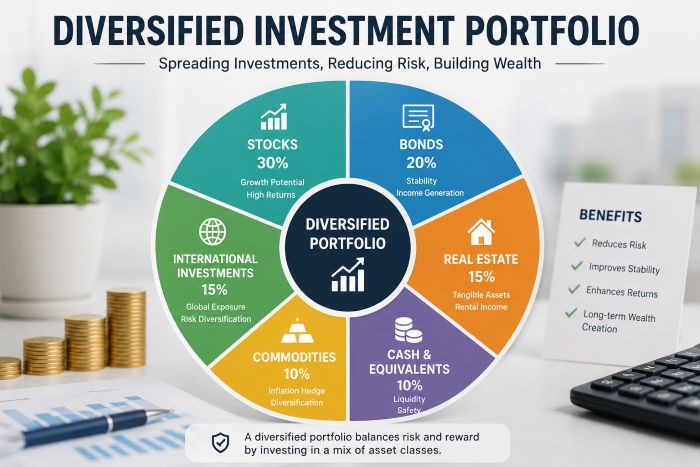
A diversified investment portfolio is one of the ways to lower risk while working toward long-term financial goals. Of putting all your money into one place diversification spreads your investments across different types of assets, different industries and different places around the world. This method helps protect your money from swings in the market because when one part of your portfolio does not do well another part might do better and help make up for the loss.
Whether you are just starting out. Have experience learning how to build a diversified portfolio can help you make better financial choices and improve your chances of growing your money steadily over time.
What Is Portfolio Diversification?
Portfolio diversification means putting your money into a range of different things instead of putting all your money into one investment or one area. The idea comes from the saying “Don’t put all your eggs in one basket.”
A diversified portfolio usually includes different types of assets such as:
- Stocks
- Bonds
- Cash and things that are like cash
- Real estate
- Commodities
- Other kinds of investments
Each of these types of investments reacts differently when the economy changes, which helps keep the whole portfolio more stable.
Why Diversification Is Important
Diversification has important advantages.
Reduces Investment Risk
No investment is always good. A diversified portfolio makes it less likely that one bad investment will hurt the group.
Provides More Stable Returns
Even though diversification can’t stop losses it helps make the overall returns more steady over time by balancing good times and bad times.
Protects Against Market Volatility
Markets change all the time because of inflation, interest rates, politics and the economy. Diversified portfolios are better at handling these changes than portfolios that are not spread out.
Supports Long-Term Wealth Growth
Investors who keep their portfolios diversified are usually in a position to take advantage of long-term changes in the market while not taking too much risk.
Know Your Investment Goals
Before you start investing think about what you’re trying to achieve.
Ask yourself:
- What am I saving for?
- How until I need the money?
- How risk am I okay with?
- Do I need regular money or long-term growth?
Your answers will help you decide what kind of portfolio is best for you.
Check Your Risk Tolerance
Risk tolerance is different for everyone.
Conservative Investors
These people care more about keeping their money safe. Their portfolios usually have bonds and cash.
Moderate Investors
These people look for a mix of growth and safety. Their portfolios have a mix of stocks and bonds.
Aggressive Investors
These people are looking for growth over time. Can take more risk. Their portfolios usually have stocks.
Choose the Right Mix of Investments
Asset allocation is one of the important choices you will make.
| Investor Type | Stocks | Bonds | Cash |
|---|---|---|---|
| Conservative | 30% | 60% | 10% |
| Moderate | 60% | 35% | 5% |
| Aggressive | 80% | 15% | 5% |
These numbers are examples and should be changed based on what works for you.
Diversify Within Each Type of Investment
Diversification is not about having different types of investments.
Stock Diversification
Spread your money across:
- Big companies
- Medium- companies
- Small companies
- Growth stocks
- Value stocks
- Companies in your country
- Companies in other countries
Also spread across many different industries like:
- Technology
- Health care
- Financial services
- Consumer goods
- Energy
- Utilities
- Industries
Bond Diversification
Include different kinds of bonds:
- Government bonds
- Corporate bonds
- Municipal bonds
- Short-term bonds
- Long-term bonds
- Bonds that protect against inflation
This helps lower the risk from interest rate changes and problems with credit.
Think About International Investments
Investing in your own country puts your money at risk from local economic problems.
International diversification gives you access to:
- Countries with developed economies
- Countries that are growing fast
- Different types of money
- Economies that are growing quickly
International investments can help make your money grow more over time and reduce your risk from one place.
Use Index Funds and ETFs
For people, index funds and Exchange-Traded Funds (ETFs) are a simple way to spread out your money.
Benefits include:
- Low costs
- coverage of the market
- Help from professionals
- Easy to buy and sell
- Less risk from one company
Many people build a whole diversified portfolio using just a few big market ETFs.
Add Estate to Your Portfolio
Real estate is another way to spread out your investments because real estate markets do not always move the same as stock markets.
You can get real estate exposure through:
- Renting property
- Real Estate Investment Trusts (REITs)
- Funds that invest in real estate
estate can give you money from rent and also grow in value over time.
Don’t Forget About Cash
Keeping some of your money in cash or things that are like cash gives you flexibility.
Benefits include:
- Money to use when you need it
- Protection when the market drops
- Chances to buy more when prices go down
But keeping much cash can make your money grow less over time because of inflation.
Avoid Much Diversification
Having too many investments can be hard to manage and may not help your returns.
Of buying hundreds of different things focus on a portfolio that is:
- Well Balanced
- Easy to watch
- Cost effective
- Matches your goals
Quality diversification is usually better than too much diversification.
Rebalance Your Portfolio
Over time the values of your investments change and your mix of investments changes.
For example:
If you want:
- 60% stocks
- 40% bonds
But stocks perform exceptionally well your mix could become:
- 75% stocks
- 25% bonds
This makes your risk higher.
Rebalancing means selling some investments and buying others to get back to your mix.
Many people do this once or twice a year.
Keep an Eye on Costs
Fees can take a lot of your money over time.
Watch for:
- Costs of the fund
- Fees for buying and selling
- Management fees
- Costs of each transaction
- Taxes
Even small differences in fees can add up to a lot of money over years.
Don’t Let Emotions Control Your Investments
Good investing needs discipline.
Common mistakes include:
- Buying when the market’s hot
- Selling when the market drops
- Trying to guess what will happen next
- Changing your plan too often
Instead follow your plan and think about the long term.
Sample Diversified Portfolio
| Asset Class | Allocation |
|---|---|
| Domestic Stocks | 35% |
| International Stocks | 20% |
| Bonds | 30% |
| REITs | 10% |
| Cash | 5% |
This is one example and should be changed to fit your needs.
Common Mistakes to Avoid
Many people make mistakes that hurt their long-term results.
These include:
- Investing without a plan
- Buying what is popular now
- Not spreading out your investments
- Forgetting to check your mix
- Paying much in fees
- Investing based on feelings
- Not looking at other countries
- Taking on more risk than they should
Avoiding these problems can help you do better over time.
Best Practices for Building a Diversified Portfolio
Think about these rules:
- Set your goals.
- Know how risk you can take.
- Choose your investments wisely.
- Spread out across industries and countries.
- Use low-cost index funds or ETFs when possible.
- Check your mix on a basis.
- Keep costs
- Stay invested for a time.
- Keep learning about money.
- Look at your portfolio each year.
Conclusion
Building a diversified investment portfolio is not about finding the big winner—it is about creating a plan that can handle changes, in the market. By spreading your money across types of assets different industries, different company sizes and different places you lower your chances of losing too much while improving your chances of growing your money steadily.
A good portfolio also needs checking staying steady and knowing what you want and how much risk you can handle. Markets will always have ups and downs. A well-diversified portfolio is made to help you stay confident during tough times. With patience working regularly and making choices diversification can be one of the strongest parts of your money plan.
Also read : Best Long-Term Investment Strategies